A wooden high chair is exactly what it sounds like — a chair built from wood (usually beech, birch, or rubberwood) designed to seat an infant or toddler at table height during meals. The “grows with me” category — sometimes called grow-with-me or convertible high chairs — goes one step further: these chairs are engineered to adjust as your child grows, transitioning from a supported infant seat through toddler dining and, in some cases, all the way to a standard chair a school-age child or adult can use. That arc matters more than it might seem on the showroom floor. A chair you buy at six months of age that you’re done with at eighteen months is a different financial proposition than one that earns daily use for eight to ten years. This guide will help you read the spec sheet with clear eyes, compare the models that dominate the conversation in 2026, and make a decision you won’t revisit in eighteen months when your toddler outgrows a chair you paid $250 for.
| EDITOR'S PICK[Abiie Beyond Junior Wooden High](https://www.amazon.com/dp/B0BS1N51MS?tag=greenflower20-20)… | Mid-tier6 in 1 High Chair for Babies &… | Budget pickWooden High Chair for Baby & To… | |
|---|---|---|---|
| Max weight | 250 Lb | — | — |
| Material | Wood | Wood | Solid wood |
| Configurations | 3-in-1 | 6-in-1 | — |
| Tray removable | ✓ | ✓ | — |
| Harness type | — | 5-point | — |
| Stackable | — | — | ✓ |
| Price | $202.30 | $110.49 | $67.14 |
| See on Amazon → | See on Amazon → | See on Amazon → |
What “Adjustable” Actually Means — and What It Doesn’t
The word adjustable is doing a lot of work in this category, and manufacturers are not always honest about its scope. Before you read any product listing, it helps to have a mental taxonomy of what can actually adjust on a grow-with-me wooden high chair.
Seat height is the most common adjustment. Nearly every chair in this tier lets you reposition the seat board across a range of notches or slots — typically three to seven positions — so the child sits at or near table height as they grow. This is table stakes (no pun intended), and its presence alone does not make a chair genuinely grow-with-me.
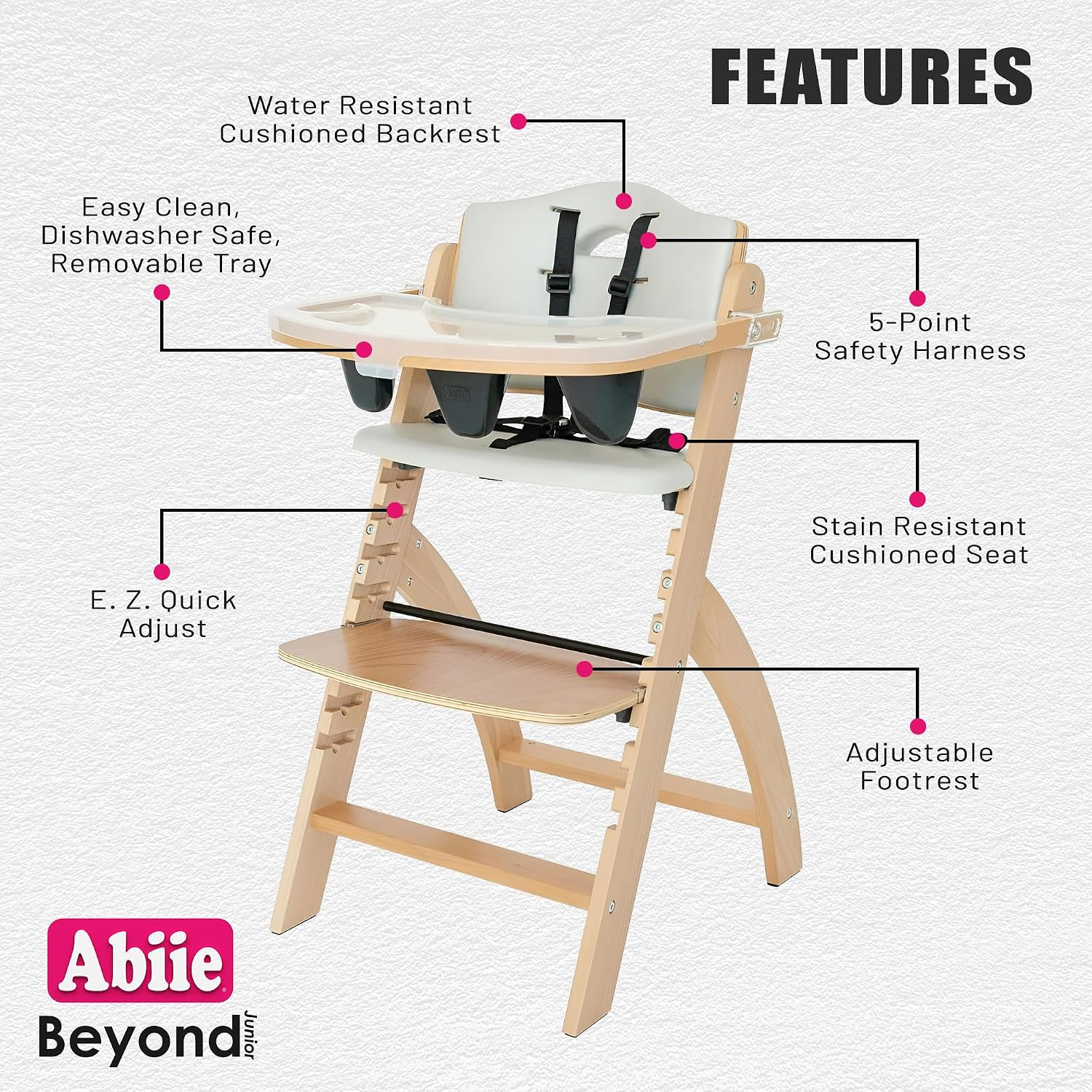
Footrest height is where you start separating real ergonomic design from marketing language. A properly positioned footrest — one that lets a child’s feet rest flat rather than dangling — supports hip flexion and reduces fidgeting at mealtimes. The American Academy of Pediatrics feeding guidance consistently notes that supported seating reduces mealtime distress in toddlers. Most plastic high chairs omit an adjustable footrest entirely; in the wooden premium segment, its presence or absence is a meaningful quality signal.
Seat depth and backrest angle adjustments are rare but exist on the top-tier models. These matter primarily in the infant phase, when a child cannot yet sit independently and needs more recline and lateral support.
Harness removal / tray removal is the conversion step most parents underestimate. A chair that advertises use “from 6 months to adulthood” is technically correct if you can remove the harness and tray and push it up to the table — but if the chair looks obviously like a high chair without those accessories, a seven-year-old will resist sitting in it. Aesthetic continuity after conversion is a real factor in whether you actually get the years of use the manufacturer promises.
The Benchmark Models: Where the Market Actually Sits in 2026
The wooden adjustable high chair category is not crowded at the top. Four models account for the vast majority of long-term parent reviews and resale activity. Here’s how they compare on the dimensions that matter.
Stokke Tripp Trapp remains the editorial consensus pick across most major publications. Wirecutter’s high chair review names it the top pick for families willing to invest in longevity, citing its seven adjustable seat positions, the independently adjustable footrest, and a design that converts cleanly into a standard chair for adults. The beech construction is manufacturer-rated for up to 330 lbs in chair mode. Apartment Therapy’s long-term coverage consistently finds that owners report using Tripp Trapps for a decade or more, with multiple children cycling through the same frame. The chair lists at approximately $299 for the base frame (newborn and baby sets sold separately), and secondary market prices for used frames in good condition hold between $100–$180 depending on color and condition — an unusually strong resale curve for a baby product.
IKEA ANTILOP is not a grow-with-me chair and appears here only because it is the most common alternative parents consider before stepping up. It has no height adjustment, no footrest, and converts to nothing. It earns its place on store shelves through price ($25–$30) and ease of cleaning. If you’re reading this guide, you’ve already graduated past the ANTILOP calculation.
Nomi by Evomove is the Tripp Trapp’s closest serious competitor and the chair that draws the most direct comparisons in parent forums and review roundups. The Spruce’s wooden high chair guide highlights its seven seat height positions, six footrest positions, and the fact that it ships as a single unit (no accessory sets required to use it with an infant, if you purchase the harness). The design is arguably cleaner than the Tripp Trapp — the seat height is adjusted with a single knob rather than repositioning the seat board — which owners in aggregated reviews report makes between-meal adjustments genuinely fast. List price is approximately $350–$380, making it the premium option in the category. Resale data is thinner than Stokke’s (the brand is newer to North American distribution), but the build quality signals suggest it should hold value comparably.
Abiie Beyond Wooden High Chair occupies a middle ground: nine height positions, a footrest that adjusts independently, and a list price around $200–$230 that undercuts Stokke without replicating the IKEA compromise. Good Housekeeping’s high chair review notes that owners consistently report solid build quality but flag that the conversion to standard chair mode is less seamless aesthetically than the Tripp Trapp — the chair retains visual cues of its high chair origins in a way that may limit real-world use past age four or five.
By the numbers
| Model | Seat positions | Footrest adjustable | Weight limit (chair mode) | Approx. list (2026) | Resale floor (used, good condition) |
|---|---|---|---|---|---|
| Stokke Tripp Trapp | 7 | Yes | 330 lbs | ~$299 | $100–$180 |
| Nomi by Evomove | 7 | Yes (6 positions) | 242 lbs | ~$360 | Limited data |
| Abiie Beyond | 9 | Yes | 250 lbs | ~$220 | $80–$120 |
| IKEA ANTILOP | None | No | ~33 lbs (tray only) | ~$28 | N/A |
Reading Durability: What the Wood Species and Finish Actually Tell You
Wood species matters, but not always in the way parents expect. Beech (used by Stokke and most European-origin brands) is a dense, tight-grained hardwood with good resistance to splitting and warping — well-suited to a chair that will be repositioned frequently over years. Rubberwood (common in sub-$150 wooden chairs) is technically a hardwood but is softer and more prone to finish wear under repeated cleaning. Birch sits in the middle.
The finish is arguably more important than the wood species for longevity in a feeding context. A lacquered or painted chair will show wear at the seat board edges and footrest notches faster than an oiled or UV-cured finish, simply because those adjustment points are load-bearing and frequently moved. Consumer Reports’ high chair buying guide recommends looking for chairs where the finish is described as food-safe and moisture-resistant — not just “non-toxic” (which describes composition, not durability under repeated wiping).
One pattern that shows up consistently in long-horizon parent reviews: chairs purchased secondhand in good cosmetic condition from a first family often serve a second family for years with no structural issues. That’s a useful proxy for real-world durability — if the design held up through one child’s full arc, the engineering is sound.
The hardware question. Wooden grow-with-me chairs rely on metal bolts, cam locks, or track systems to hold the seat and footrest at the correct height. These are the failure points to examine before purchase. On the Tripp Trapp, the seat board slides into a channel and is secured by a single bolt on each side — owners report that the original hardware holds through years of adjustment, and replacement hardware is sold by Stokke directly. On budget alternatives, plastic locking mechanisms at the footrest are the first things to fail. If the spec sheet doesn’t name the fastener material, that’s a yellow flag.
The Resale Math: Why This Purchase Is Different From Most Baby Gear
Most baby gear depreciates sharply and quickly. Strollers, bouncers, and swings go from $400 new to $80 used within a year, if they sell at all. Wooden grow-with-me high chairs from the brands above behave more like furniture than like baby products — which changes the real cost calculation meaningfully.
A Stokke Tripp Trapp purchased new at $299 in 2026, used for eight to ten years across one or two children, and sold for $130 in good condition represents a net cost of roughly $17–$21 per year of use. That’s below the annualized cost of most $80 plastic high chairs, which have no resale value and a realistic useful life of eighteen to twenty-four months.
The Abiie Beyond at $220 with an estimated resale of $90–$100 delivers similar math at a lower upfront number — making it the right call for families who aren’t certain they’ll stay in a space long enough to run the full arc, or who want to limit initial outlay.
The Nomi’s resale market is still maturing. If you’re optimizing purely on financial efficiency, the thinner secondary market is a real risk factor to price in.
The Decision Rule
If you’re comparing these chairs right now with a decision pending, here’s the framework:
If you have one child and a long time horizon (5+ years in your home), buy the Tripp Trapp. The resale curve is proven, the replacement parts ecosystem is real, and the chair converts credibly enough that school-age children will actually use it. Pay the $299 and stop deliberating.
If upfront cost is the binding constraint, buy the Abiie Beyond. The adjustability specs are genuinely competitive, the wood quality earns consistent owner praise, and you’re giving up some resale ceiling and some aesthetic polish — not structural function. It’s a legitimate second-place finish, not a consolation prize.
If you want the cleanest design and don’t mind paying a premium for it, the Nomi is worth a look — with the caveat that you’re accepting thinner secondary market liquidity if your situation changes.
Avoid any wooden high chair under $120 that markets itself as “grow-with-me.” At that price point, the footrest mechanism is almost always plastic, the seat adjustment is rarely smooth after six months of use, and the resale value is effectively zero. You’re buying eighteen months of function at best. The math doesn’t work.
The category is not complicated once you’ve mapped the actual variables — and the brands that have earned the long-term reviews have earned them for reasons that hold up to scrutiny. Buy once, buy deliberately, and the chair pays for itself before your child outgrows it.