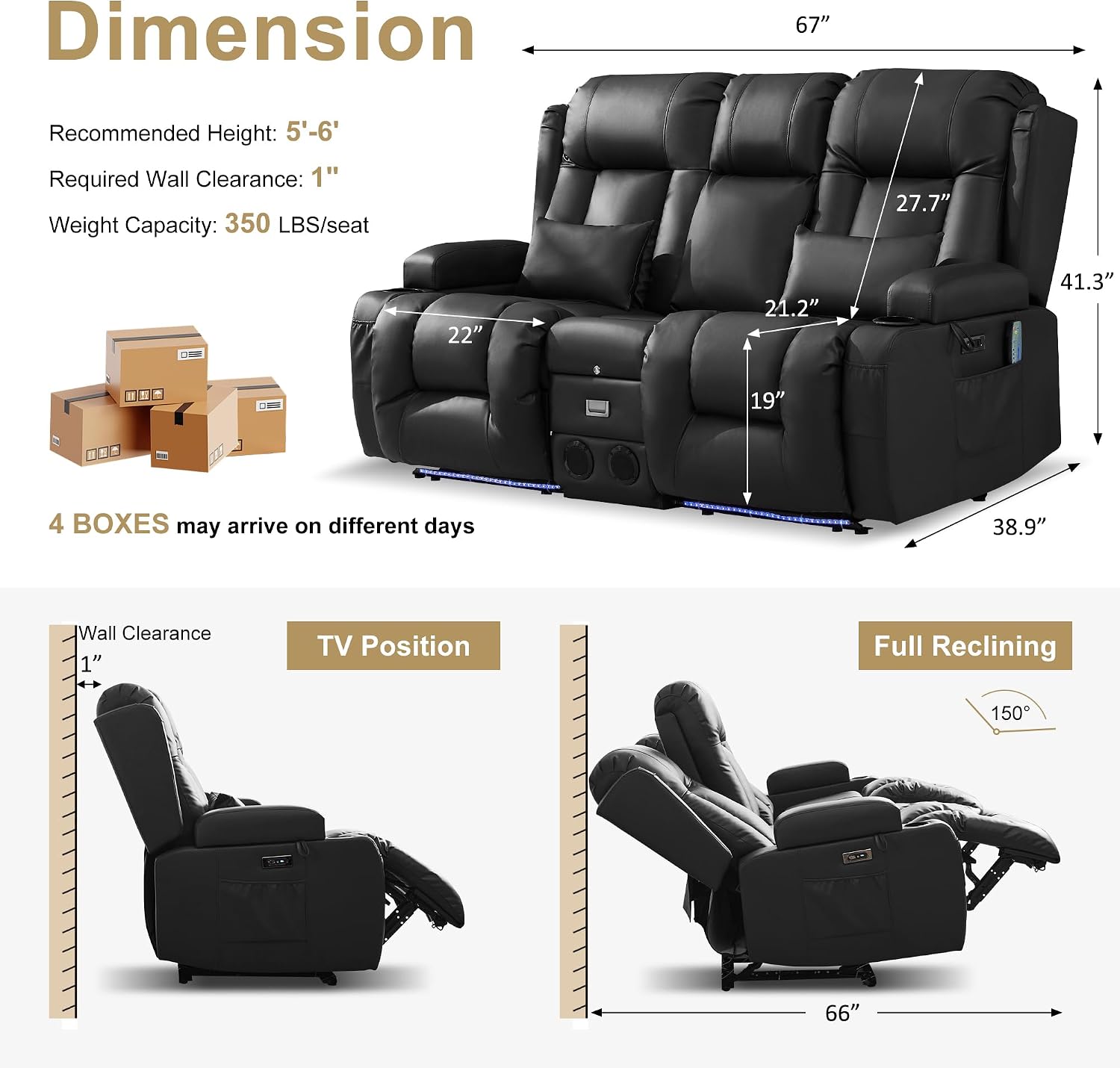
A home theater loveseat recliner is exactly what it sounds like: a two-person sofa (the “loveseat” format, roughly 60–66 inches wide) with power-operated reclining mechanisms built into each seat, designed specifically for dedicated home screening rooms or media spaces. Unlike a standard living-room sofa, these pieces are engineered for extended viewing sessions — full lay-flat or deep-recline positions, integrated armrests with storage, and often built-in USB charging ports or cup holders. The catch, which surprises a lot of first-time buyers, is that the reclining mechanism doesn’t just push you back — it also physically moves the seat forward and projects the footrest out. That extension into the room is what makes wall placement the single most consequential measurement decision you’ll make before purchase. Get it wrong, and a $3,000 seat hits the wall every time you recline, or worse, you’re sitting eight feet from a screen sized for four.
This article is for buyers who’ve already decided they want a power-reclining loveseat for a home theater and are now in the weeds of spec comparison, room layout, and feature prioritization. We’ll cover the clearance math in plain numbers, what the center console actually gives you (and costs you), and the honest truth about wall-hugger technology — including when it’s worth specifying and when it’s marketing.
The Wall Clearance Math Nobody Puts on the Product Page
Here’s the core problem with recliner spec sheets: they tell you the seat’s overall dimensions in the upright, showroom-ready position. They rarely prominently feature what the footrest extension adds to the front of the piece, and almost never clearly communicate the rear clearance required for a standard (non-wall-hugger) mechanism to fully recline.
A standard power recliner extends its backrest by tipping rearward. The pivot point is behind the seat, which means the top of the backrest arcs backward and downward as it reclines. The result: a chair that sits 36 inches from the wall in its upright position may require 12–18 additional inches of rear clearance to reach full recline. That’s the chair’s backrest swinging into what you thought was empty space.
By the numbers — typical standard-mechanism power loveseat:
| Position | Rear wall clearance needed | Front-of-footrest projection |
|---|---|---|
| Upright (showroom) | 0–3 in. (back nearly flush) | Seat depth only (~22 in.) |
| Partial recline (~130°) | 6–10 in. behind back | +8–12 in. beyond seat front |
| Full recline (~170°) | 12–18 in. behind back | +16–22 in. beyond seat front |
Figures reflect typical ranges across Palliser and Valencia published spec documentation; individual models vary. Always request the manufacturer’s full-extension diagram, not just the product-page silhouette.
The footrest projection matters for row planning. If you’re building a two-row setup — a common configuration in purpose-built screening rooms — the footrest of the rear row and the back of the front row need clearance between them at full extension. Architectural Digest’s 2024 home theater design guide recommends a minimum of 48 inches between rows measured seat-back to seat-back in the upright position, which still leaves tight tolerances when both rows are fully reclined simultaneously. In practice, forum members in the AVS Forum Home Theater Seating Megathread frequently report that 54–60 inches between rows is the comfortable working number once full-extension footrest clearance is factored in.
The actionable step before any purchase: tape out your room. Mark the seat’s upright footprint, then add the full-extension footrest projection forward and the rear clearance backward. This takes 20 minutes and costs nothing. Skipping it costs you a return shipping dispute.
Wall-Hugger Technology: What It Is, What It Actually Solves, and Where It Falls Short
“Wall-hugger” (sometimes called “space-saver” or “wall-away” reclining) is a mechanism design where the entire seat slides forward on a track as the backrest reclines. The forward slide compensates for the backward arc of the backrest, keeping the top of the seat back at roughly the same distance from the wall throughout the recline cycle. In theory, you can place a wall-hugger recliner 3–5 inches from the wall and fully recline without contact.
In practice, the claims hold up — but with nuance that matters for buyers specifying seats in constrained rooms.
What wall-hugger solves: It genuinely does eliminate rear clearance as a constraint. Owners across aggregated reviews on AVS Forum consistently report that wall-hugger models from Valencia, Palliser, and Octane Seating deliver on the 3–6 inch rear clearance promise at full recline. If your room is rear-wall constrained — a common scenario when risers push seating close to the back wall — wall-hugger is a legitimate design tool, not just marketing.
What wall-hugger does NOT solve:
-
Front projection still happens. The seat slides forward to accommodate the backrest mechanism. That forward slide — typically 8–12 inches in a power loveseat — adds to your front-of-seat footrest projection. The footrest still extends. You’re trading rear clearance for front projection, not eliminating the extension math entirely.
-
Row spacing in multi-row setups. If you have a front row of wall-hugger seats on a flat floor and a rear row on a riser, the rear row sliding forward during recline is fine. But a front row on the floor sliding forward while fully reclined moves into the space between rows, which can create a clearance problem for the rear row’s footrest if you haven’t planned for it.
-
The cost premium. Wall-hugger mechanisms add cost. Published pricing across Palliser’s 2025 product documentation shows wall-hugger power loveseat configurations running $200–$400 more than equivalent standard-mechanism models in the same fabric and frame grade. For buyers who already have adequate rear clearance — say, 18 or more inches behind the planned seat position — specifying wall-hugger is spending money to solve a problem you don’t have.
Decision rule: If rear wall clearance is under 12 inches in the upright position, wall-hugger is likely worth the premium. If you have 18+ inches behind the seat, skip it and apply the savings to material grade or console features.
The Center Console: Feature Breakdown and the Width Tax
The center console — the shared armrest-and-storage unit between the two seats in a loveseat configuration — is where the feature arms race in home theater seating has concentrated over the past few years. USB-C power delivery ports, wireless charging pads, lighted cup holders, pop-up storage compartments, and retractable tray tables are all available on mid-to-premium models. Here’s a clear-eyed look at what those features are worth.
What’s genuinely useful:
-
Dual cup holders with lighted rings: Owners consistently rate these as the highest daily-use feature. The lighted ring solves a real problem — finding your drink in a dark room without disrupting your screen focus. Valencia’s Tuscany and Octane Seating’s Turbo XL both offer illuminated cup holders as standard in their loveseat configurations per published spec sheets.
-
USB-A + USB-C dual charging: The shift from USB-A only to dual USB-A/USB-C became near-universal in 2024–2025 model refreshes across major brands. USB-C Power Delivery at 18W or higher is the meaningful spec — it will fast-charge a phone. Owners in long-run forum reviews note that USB-A ports on older models feel dated within 18 months of purchase given device trends. Specifying USB-C PD is forward-looking.
-
Covered storage compartment: A lidded storage well is consistently rated useful for remotes, headphones, and small accessories. Open-top trays fill with debris in a working theater environment.
What’s often oversold:
-
Wireless charging pads in the console: The placement geometry is awkward — a charging pad in a shared center console requires both users to consciously set their phone in a specific orientation in a fixed position, in the dark, mid-film. Owners in AVS Forum threads report actual use rates are low after the first month. Wired USB-C is more reliable in practice.
-
Retractable tray tables: These add ~$150–$300 per seat in premium configurations and require the user to operate a mechanism in the dark. Published reviews at The Spruce note that tray tables are a popular showroom feature that sees less in-home use than buyers anticipate.
The width tax: Here’s the tradeoff most buyers don’t price in. A full-featured center console — dual cup holders, storage, dual USB — typically measures 8–12 inches wide in a loveseat configuration. That 8–12 inches comes directly out of the total seat width budget. A loveseat spec’d at 64 inches wide with a 10-inch console gives each seat position 27 inches of actual seat width — adequate for most adults, slightly compressed for larger frames. Palliser’s published dimensions on their home theater loveseat line confirm this pattern. If adult occupants are on the larger side, consider whether a console-heavy configuration delivers enough per-seat width, or whether a model with a narrower 6-inch console (fewer features, more seat width) is the better call.
Material Grade, Power Mechanism, and the Warranty Reality
Home theater loveseats at the $1,800–$4,000 per-seat tier (roughly $3,600–$8,000 per loveseat pair as a unit) typically come in three material categories: bonded leather (avoid in this tier — it delaminates, typically within 3–5 years per owner-reported patterns in AVS Forum reviews), top-grain leather, and performance fabric. Top-grain leather and performance fabric are the legitimate long-term materials at this price point.
The power reclining mechanism is where warranty language matters most and where The Spruce’s recliner buying guidance and AVS Forum owner reports diverge most sharply from manufacturer marketing. Look for:
- Mechanism warranty: 3 years minimum on the power mechanism is the floor for this tier. Palliser and Fortress both publish 3-year mechanism warranties; some Valencia configurations offer 5-year mechanism coverage at the premium tier.
- Frame warranty: Lifetime frame warranties are common in this category and are generally reliable per owner report patterns.
- What’s NOT covered: Motor replacement outside the mechanism warranty window, damage from use in non-ventilated base configurations, and “normal wear” on leather grade lower than full-grain are common exclusions in the fine print that owners report discovering only at claim time.
If X, Then Y — The Decision Rules
You’ve done the room tape-out, you’ve pulled spec sheets, you’re comparing two or three models. Here’s how to break the tie:
- If rear wall clearance is under 12 inches: Specify wall-hugger, accept the front-projection tradeoff, plan row spacing accordingly.
- If you’re building two rows: Budget 54–60 inches between rows (upright measurement) and verify both rows’ full-extension footrest projections won’t overlap.
- If adult seat occupants are large-frame: Prioritize per-seat width over console feature count; a narrower console and 29+ inches per seat position is the better tradeoff.
- If you’re choosing between bonded leather and top-grain at a similar price: Always take top-grain. The longevity math is not close.
- If the feature list includes wireless charging but not USB-C PD: That’s a value-engineering signal. Push for USB-C PD as a negotiating point or move to the next model tier.
- If the mechanism warranty is under 3 years at a price above $2,000 per seat: That’s a red flag worth raising before purchase, not after.
The room is fixed. The seats have to work within it. Do the math before the showroom visit, not after delivery.