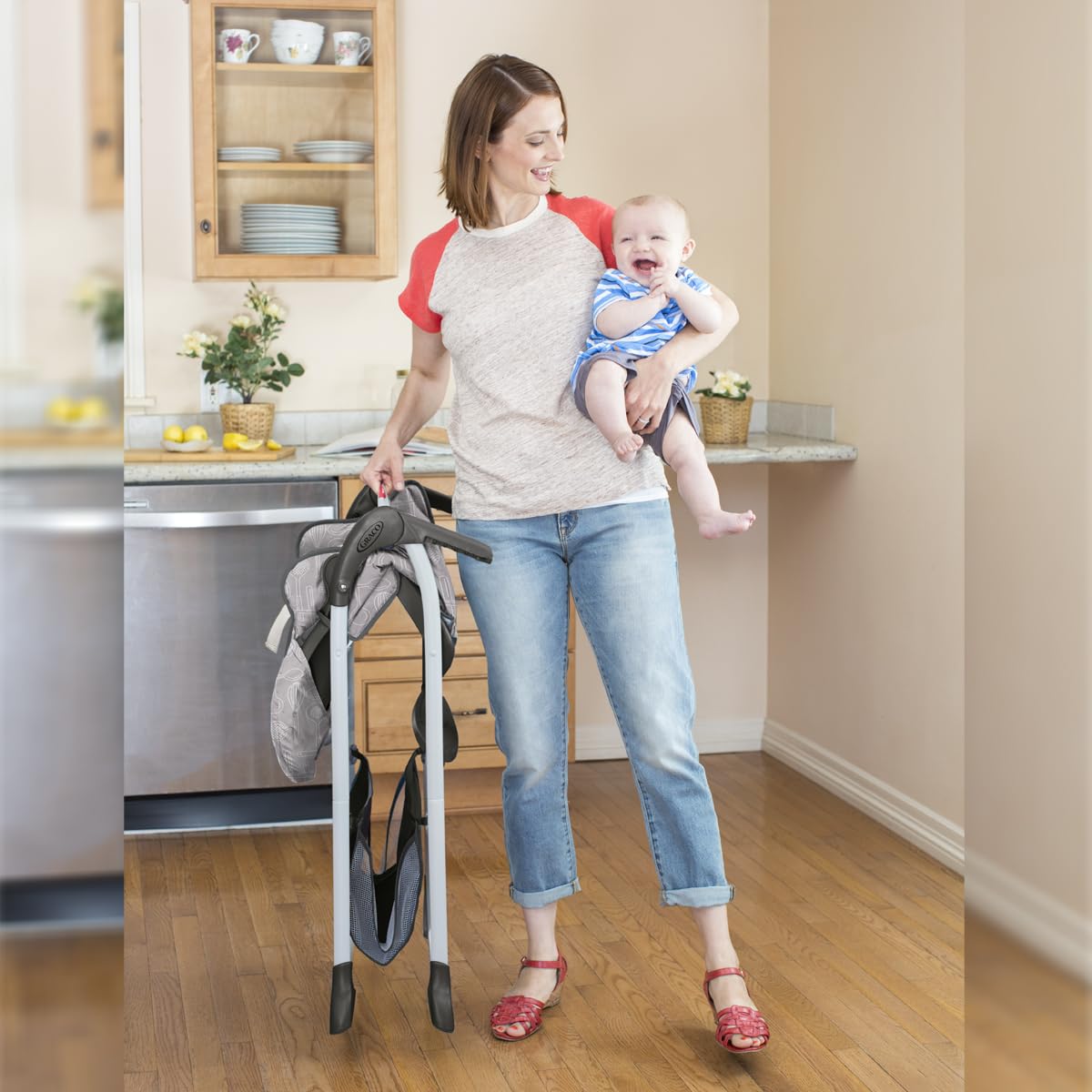
A convertible high chair is exactly what the name suggests: a seat that starts as a full infant feeding station—with a tray, harness, and elevated position—and reconfigures as your child grows, eventually becoming a toddler booster or even a stool you can use at a regular table. The “convertible” pitch matters most to parents in tight spaces, because you’re not buying a piece of equipment for 18 months—you’re buying furniture that may live in your kitchen for five or six years. For a family in a 700-square-foot apartment or a galley kitchen, every square foot of floor space is a real decision, not a rounding error. This article is about how to measure your actual kitchen, decode manufacturer fold dimensions, and decide whether the “grows with your child” promise is real enough to justify a $200–$300 chair over an $80 option that’ll end up on the curb by kindergarten.
| EDITOR'S PICK[Graco EveryStep 6 in 1 High Cha…](https://www.amazon.com/dp/B0BDSWVGJN?tag=greenflower20-20) | Mid-tier[Dream On Me TableTalk 2-in-1 Hi…](https://www.amazon.com/dp/B089PKKPBV?tag=greenflower20-20) | Budget pick[Graco® Slim Snacker High Chair](https://www.amazon.com/dp/B0BDSWVGJN?tag=greenflower20-20) | |
|---|---|---|---|
| Convertible Stages | 6 stages | 2 stages | — |
| Folding Mechanism | — | — | Fast-fold |
| Tray Details | — | Dual dishwasher-safe | — |
| Frame Material | — | Steel | — |
| Recline Positions | — | — | Multiple |
| Dimensions | Slim | — | Ultra slim |
| Price | $174.79 | $56.94 | |
| See on Amazon → | See on Amazon → | See on Amazon → |
The Footprint Math Nobody Puts in the Product Listing
Here’s the number that matters: base footprint while the chair is in use, not the “folded dimensions” listed in the spec sheet. Most marketing leads with the fold, because it’s the smaller number. But your child will spend roughly one to three hours per day in that chair, and it needs a real home during those hours.
Pull up a tape measure. A standard high chair footprint runs 18–22 inches wide by 22–26 inches deep. That sounds manageable until you account for clearance. You need roughly 6–8 inches on each side for a caregiver to stand and load a child without torquing their back into a weird angle—a point Consumer Reports’ High Chair Buying Guide flags when discussing safe harnessing technique. Add another 6–10 inches of depth behind the chair for the caregiver’s feet during feeding. In practice, a single high chair in active use claims a roughly 3-foot-by-3-foot operating zone—about 9 square feet of floor space you cannot use for anything else during meals.
In a kitchen under 100 square feet, that’s a meaningful commitment. Knowing this number in advance lets you decide: Can this chair live in its feeding position between meals, or does it need to fold and store?
By the numbers — typical footprint comparison across common compact models:
| Model | Base Footprint (in use) | Folded Depth | Folded Height | Weight |
|---|---|---|---|---|
| Stokke Tripp Trapp | 19” W × 20” D | Does not fold flat | 34” H (standing) | 14.8 lbs |
| Graco Slim Snacker | 16.5” W × 22” D | 8” D | 36” H | 11.6 lbs |
| Joovy Nook NB | 16” W × 22” D | 9” D | 38” H | 16 lbs |
| Inglesina Fast Table Chair | 0” floor (table-mount) | 4” D | N/A | 5 lbs |
Published specs per manufacturer; verify current dimensions at point of purchase as models update.
The Graco Slim Snacker earns its name—16.5 inches wide is genuinely narrower than most competitors, and the fold is real: owners consistently describe it as a one-hand operation that can be done while holding the baby. Apartment Therapy’s roundup of high chairs for small spaces has called it out specifically for this reason. The Stokke Tripp Trapp, on the other hand, does not fold at all—it’s a precision-engineered piece of furniture designed to live in your dining space permanently, and it’s a different kind of space bet.
Fold Dimensions: What “Compact When Folded” Actually Means
This is where intermediate buyers get burned. “Folds flat” and “compact fold” are marketing descriptors with no standardized meaning. Here’s how to decode them before you buy.
Three distinct fold categories exist in the market:
-
Flat fold — The chair collapses to a slab roughly 4–6 inches thick. Can slide behind a door, lean against a wall between cabinets, or go in a closet. Graco Slim Snacker and Joovy Nook NB operate in this range. This is the only fold type that genuinely solves the “store between meals” problem in a galley kitchen.
-
Upright fold — The chair’s legs collapse inward but the unit still stands 34–42 inches tall and 6–12 inches deep. It needs floor space, just vertical floor space. Better for a corner than a closet. Some parents report leaving these folded in a dining room corner between meals. Not a solution if you lack that corner.
-
Does not fold / designed to live open — Stokke Tripp Trapp is the category-defining example. The philosophy here is different: the chair is designed to join your table setting, be used by adults and older children too, and become part of your room rather than disappear from it. If you’re considering a Tripp Trapp, your question isn’t “where does it store?” It’s “is this chair attractive enough to earn permanent floor space in my kitchen?”
The Wirecutter high chair review (New York Times Company, updated 2025) draws this distinction explicitly, noting that the Tripp Trapp is a better fit for families who will use it long-term as dining room furniture rather than families who need to break down and store equipment between uses.
One underrated spec: folded weight vs. base weight. A chair that weighs 22 pounds folds just as fast as one that weighs 11 pounds—but the heavier one is significantly harder to move to a closet one-handed while the other arm is occupied. Good Housekeeping’s high chair coverage consistently notes weight as an overlooked factor for frequent folders.
The Grow-With-Me Reality Check
Every convertible high chair promises years of use. Here’s how to separate the ones that deliver from the ones that collect dust after month 18.
The conversion stages that actually matter:
- Infant recline + 5-point harness — typically usable from 6 months (sometimes earlier with an infant insert)
- Upright feeding position with tray — the primary high chair mode, months 6–24
- Tray-removed, table-height position — the chair slides to the table; child uses it like a booster. This is where many chairs fail, because the footrest and seat height may not align with your actual table height.
- Toddler/big-kid stool — the Stokke Tripp Trapp’s legitimate claim to fame; it adjusts to support a child through elementary school, and the adult weight rating (per Stokke’s published specs, rated to 242 lbs) means you can actually sit in it yourself.
The Stokke Tripp Trapp is the strongest performer at this multi-decade promise. The seat and footrest boards slide on a rail system, adjusting to a child’s growing leg length and height. Owners report using these chairs across multiple children. The Spruce’s convertible high chair roundup notes that the Tripp Trapp’s resale value remains unusually strong for baby gear—a function of its build quality and multi-year utility.
Budget-tier convertibles often convert in name only. The “toddler seat” mode may simply be the same chair with the tray removed—no height adjustment, no footrest repositioning. If your table is standard (28–30 inches high) and the chair’s table-mode seat height is 22 inches, your toddler’s chin will be at table level. That’s not a usable seat; it’s a prop. Consumer Reports’ High Chair Buying Guide advises measuring your table height before evaluating any chair’s “converts to table seat” claim, and checking whether the footrest adjusts independently of seat height.
The honest decision tree:
-
Small kitchen, need to store between meals, budget under $150: The Graco Slim Snacker is the answer. Its flat fold is genuine, the footprint is the narrowest in the segment, and while it won’t win a design award, owners consistently report it survives the 18-month infant-to-toddler window without mechanical failure. After that, most families move to a booster seat clipped to a dining chair—a separate $40–$80 product—rather than relying on the convertible function.
-
Small kitchen, willing to give the chair permanent floor space, budget $300+: The Stokke Tripp Trapp earns its footprint because it earns long-term utility. The chair’s geometry is compact enough (19” × 20” base) that it fits at a standard dining table without sticking out awkwardly. If you have a dedicated dining chair position for your child, this chair occupies it for years, not months.
-
Really tiny kitchen, no floor space to spare: Look at table-mount seats. The Inglesina Fast Table Chair mounts to your table edge and has no floor footprint whatsoever—published specs show it fits tables 0.6”–2.2” thick, and it weighs about 5 pounds. The tradeoff is that it requires a structurally solid table edge (glass tables are out, as are most pedestal tables), and the usable window is shorter—typically 6 months to about 3 years, 33 lbs max per Inglesina’s published weight limit.
Making the Call: If X, Then Y
The convertible high chair market has three real segments, and the right pick depends almost entirely on your kitchen’s spatial arithmetic—not which chair has the most Instagram presence.
If your kitchen requires folding and storing the chair at least once per day: The flat-fold category (Graco Slim Snacker, Joovy Nook NB) is your only realistic option. Any chair that folds to an upright slab will erode your patience within a month, and you’ll end up leaving it open anyway—defeating the point.
If the chair can stay deployed between meals but needs to earn its footprint with multi-year utility: The Stokke Tripp Trapp at $299–$329 (current 2026 MSRP range) makes the per-year cost math work over a five-year horizon. That’s roughly $60–$65 per year for a chair that functions as actual furniture. Owners in long-term reviews note strong resale value if you do eventually sell it, which further improves the cost picture.
If you have zero floor space and a table with solid edges: Table-mount seats are an underused category. They’re not ideal for every meal (you can’t easily move a child from a table-mounted seat mid-meal), but for families in genuine micro-kitchens, they solve the problem the other categories can’t.
One final note: whatever chair you select, verify its JPMA (Juvenile Products Manufacturers Association) certification before purchase. This is a third-party safety certification, not a manufacturer self-declaration, and it’s the baseline standard worth confirming. Neither price point nor brand recognition substitutes for it. Consumer Reports maintains a current database of recalled and certified juvenile products that’s worth a quick cross-check before finalizing any order.
The footprint math isn’t glamorous. But running it before you order—rather than after the box arrives—is the difference between a chair that fits your life and a chair that becomes a very expensive tripping hazard.