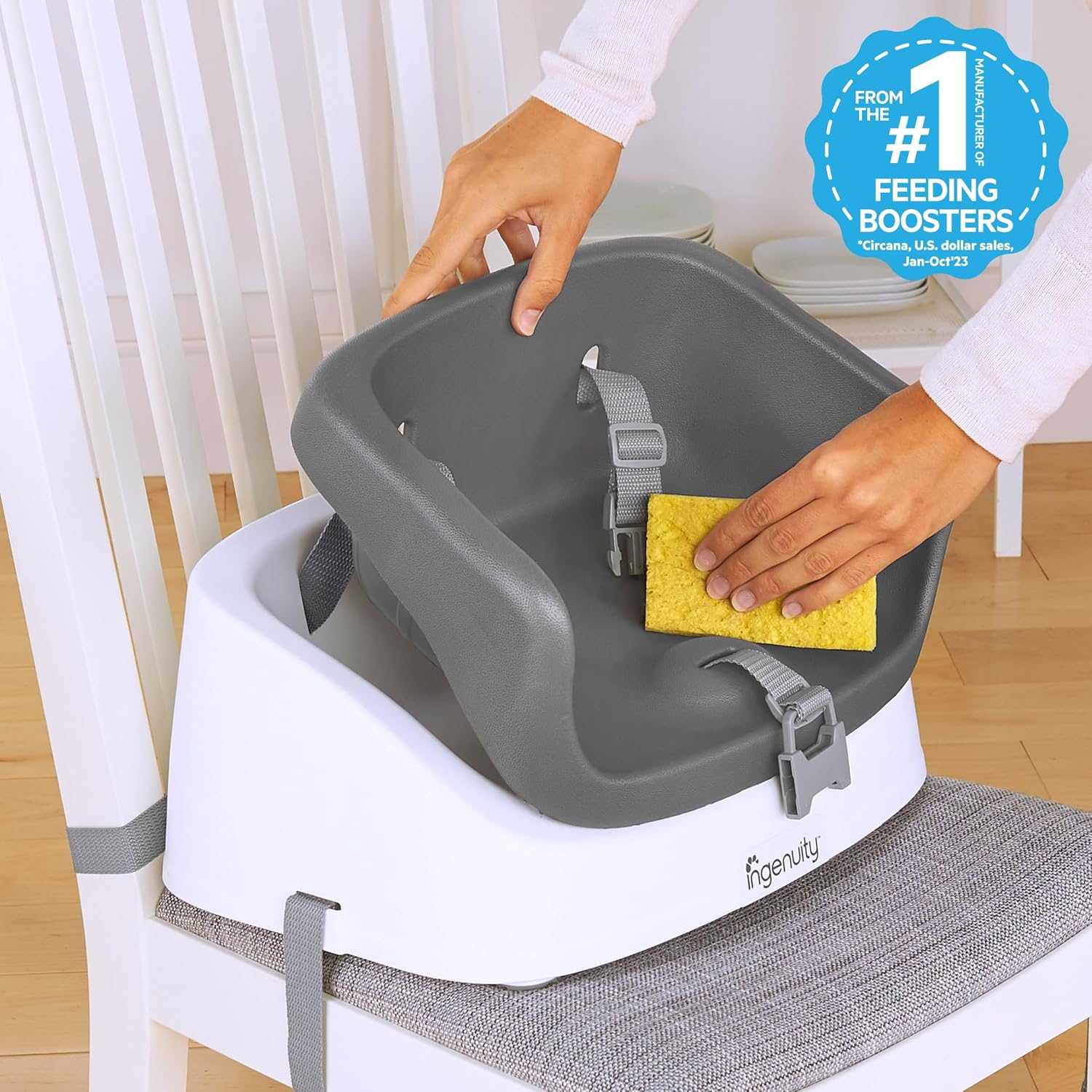
A toddler booster seat — at its simplest, a compact seat that straps onto a regular dining chair to raise a small child to table height — sounds like a minor purchase. It is not. If your household has a narrow kitchen, a frequently moved dining setup, or regular travel with a child between roughly 6 months and 4 years old, the booster you pick will be used daily, cleaned daily, and hauled in and out of cars, restaurants, and grandparents’ kitchens more times than you’ll count. The wrong choice means a harness you can’t operate one-handed at 7 a.m., a tray that collects mashed banana in places a sponge can’t reach, and a folded footprint that still won’t fit in your carry-on. This guide cuts through the spec sheet noise and maps what actually differentiates the options — so if you’re comparing two or three finalists right now, you can stop second-guessing and buy.
| EDITOR'S PICK[Ingenuity Baby Base 2-in-1 Boos…](https://www.amazon.com/dp/B0C37SRQPY?tag=greenflower20-20) | Mid-tier[Ingenuity SmartClean Toddler Bo…](https://www.amazon.com/dp/B07LBGGYGQ?tag=greenflower20-20) | Budget pickBright Starts Pop ‘N Sit Portab… | |
|---|---|---|---|
| Age Range | — | — | 6 Months–3 Years |
| Tray Included | ✓ | — | ✓ |
| Harness Type | — | 3-Point | — |
| Portable | — | ✓ | ✓ |
| Self-Storing | ✓ | — | — |
| Price | $39.99 | $23.99 | $21.65 |
| See on Amazon → | See on Amazon → | See on Amazon → |
The Three Real Decision Axes (Portability, Harness, and Clean-Up Are Not Equal)
Most buyers frame this as a single-axis problem: which one is the most portable? That’s a mistake. Portability, harness security, and clean-up ease pull in different directions, and a seat that maxes one usually compromises another. Here’s the honest tradeoff map before we get into specifics.
Portability is measured in folded dimensions, packed weight, and whether the seat ships with a carry bag. Wirecutter’s buyer guidance on portable high chairs notes that the meaningful threshold for true travel portability is under 4 lbs and a folded profile that fits inside a standard diaper bag or backpack compartment. Seats in the 5–7 lb range with carry straps are fine for car travel and restaurant use, but they’re a different product category — call them transportable, not travel-ready.
Harness security is the axis most parents underestimate until they have a child who’s figured out the buckle. The JPMA (Juvenile Products Manufacturers Association) certification — a voluntary but meaningful third-party safety standard — requires that harness hardware withstand specific force loads and that restraint systems meet documented release-resistance benchmarks. Consumer Reports’ booster seat evaluations consistently flag that many mid-range seats pass certification on paper but show harness loosening in extended use: straps that gradually work slack, or crotch posts (the post between the legs that prevents a child from submarine-sliding under the tray) that are too short for children above the 75th percentile in height. This matters more than most spec sheets communicate.
Clean-up is the axis manufacturers market most aggressively and deliver on least consistently. “Dishwasher-safe tray” on a product description almost never means the full tray assembly — it typically means the removable tray liner, which is often a separate thin plastic insert. The structural tray base, the harness webbing, and the foam seat pad are almost never dishwasher-safe. Good Housekeeping’s booster seat evaluations specifically call out this gap, noting that harness straps on most seats in the $50–$120 range are hand-wash only and tend to permanently absorb food odor after 6–9 months of use.
Portability Specs: What the Numbers Actually Mean
By the numbers — portable booster seat tier thresholds:
| Category | Folded Weight | Folded Footprint | Carry Solution |
|---|---|---|---|
| True travel (backpack/plane) | < 4 lbs | < 14” × 12” | Integrated bag or strap |
| Car-portable (restaurant use) | 4–7 lbs | < 18” × 14” | Carry strap or tote |
| Home use with occasional transport | 7+ lbs | Varies | Usually none |
The seats that genuinely qualify as backpack-portable — the Fisher-Price On-the-Go Booster and the Inglesina Fast Table Chair occupy the lightweight end, the latter using a no-tray, fabric-sling design that clamps directly to the table edge rather than strapping to a chair — sacrifice tray depth and harness adjustability to hit that sub-4-lb spec. The Spruce’s 2025 high chair round-up notes that table-clamp designs like the Inglesina are only compatible with tables that have a lip or edge between 0.5” and 2.5” thick, and fail entirely on pedestal tables with no accessible rim. If your primary use case is restaurant dining on unpredictable table configurations, a chair-strap seat is more reliable.
The Graco Slim Snacker — a common recommendation in the $60–$90 price band — threads the needle reasonably well at around 5.5 lbs with a flat-fold design. Forbes’ toddler seating guide places it as the value benchmark in the car-portable tier. It won’t disappear into a backpack, but it folds flat enough to slide behind a car seat or into the footwell of a stroller without the seat becoming the logistical event of the trip.
The OXO Tot Nest Booster and the Summer Infant Pop ‘n Sit represent the upper end of the transportable tier — 6–7.5 lbs with removable trays — and are better understood as compact home seats that tolerate being moved than as travel products. That’s not a knock; for a small urban apartment where the full-size high chair is the wrong product but a true travel seat is too minimal for daily use, this is the real solution category.
Harness Reality: What Certification Covers and What It Doesn’t
JPMA certification is the baseline you should require. It means the product has been independently tested against ASTM F1235 (the relevant standard for booster seats used at the table), which covers stability, harness strength, and warning label requirements. Consumer Reports’ buying guide makes the useful distinction that JPMA certification is a floor, not a ceiling — it tells you the product won’t catastrophically fail, but it doesn’t evaluate the day-40 experience of a strap that’s been hand-washed eight times.
The harness configurations break into three meaningful types:
3-point harness (shoulder straps connect to a single waist strap): adequate for younger, less mobile children. Offers less containment for active toddlers who have discovered that twisting sideways is a viable escape vector.
5-point harness (shoulder + waist + crotch post): the standard on full-size high chairs and the best option for children 12–36 months who are active at the table. The Graco Slim Snacker and the Fisher-Price SpaceSaver High Chair both use 5-point systems at their respective price points.
Tray-only restraint (no harness, child is contained by tray position): common on table-clamp seats like the Inglesina Fast Table Chair. Fine for children who can sit independently and aren’t prone to sudden backward lurches, but not appropriate as a primary restraint for children under 12–14 months or children who are particularly active. The Spruce and Wirecutter both note this limitation clearly in their Inglesina coverage.
One underreported issue: harness crotch-post length. The crotch post — the vertical post between the child’s legs that prevents sliding — is fixed at a specific length on most budget and mid-range seats. Children at the 90th percentile or above in torso length often find the crotch post too short to provide actual restraint benefit. If your child is tracking tall, this is a spec worth specifically asking a retailer about before buying.
Clean-Up Truth: The Gap Between Marketing and Reality
The word “easy-clean” on a booster seat box is doing a lot of work and delivering variable results. Here’s a more honest framework.
Tray assemblies on seats in the $60–$130 range typically consist of a hard plastic base and a softer removable insert. The insert is usually dishwasher-safe (top rack). The base is wipe-clean at best. The joint between insert and base is where pureed food goes to become a science project — it’s almost universally a gap or channel that requires a bottle brush or toothpick to clear. Good Housekeeping’s evaluation of booster seats notes this consistently across brands; it’s not a defect in any one product, it’s an inherent tradeoff of the insert-tray design.
Seat padding and upholstery is the bigger issue for long-term owners. Foam seat pads with removable, machine-washable covers exist — the Skip Hop Tuo is one of the few in the under-$150 range to offer a fully removable, machine-washable seat pad — but the majority of padded booster seats use fixed upholstery that wipes clean but cannot be laundered. Owners across aggregated reviews consistently report that fixed upholstery seats develop odor in the seam and crease areas within 3–6 months of daily use, regardless of how carefully they’re wiped after meals.
Harness webbing is the hardest part to keep genuinely clean. Virtually no harness webbing on seats in this category is machine-washable — machine washing degrades the webbing fibers and is typically explicitly prohibited by manufacturer warranty language. Hand-washing with mild soap is the specified care method, and it works adequately if done consistently. The practical reality reported by owners is that straps cleaned reactively (after visible soiling) rather than proactively (after every meal) develop permanent staining within two to three months. If clean harness straps matter to you aesthetically or hygienically, build a weekly strap-wipe habit from day one.
The Decision Rule
If you’re at the point of choosing, apply this framework:
-
True travel (plane, restaurants, grandparents’ houses, any table): prioritize folded weight under 4 lbs and a carry bag. Accept tray limitations and a simpler harness. The Inglesina Fast Table Chair is the editorial consensus pick for this use case — Wirecutter and Good Housekeeping both name it — with the caveat that you need table-edge compatibility.
-
Small-footprint daily home use plus occasional car transport: the Graco Slim Snacker remains the value benchmark in the $60–$90 range; the Fisher-Price SpaceSaver High Chair adds recline and more substantial tray functionality at $80–$110 if your child is under 12 months and you want the seat to grow with them.
-
Daily home use, cleanliness is a top priority, budget allows $120–$160: look at seats with removable, machine-washable seat pads. The additional cost pays for itself in extended useful life and harness hygiene.
-
Child above 90th percentile in height or particularly active at the table: prioritize a 5-point harness with an extended crotch post, and confirm the spec before purchase. The marketing copy won’t tell you this; the manufacturer’s spec sheet will.
The booster seat category rewards specificity. Know which of the three axes — portability, harness, clean-up — is your true non-negotiable, and let the others follow. Every other choice in this category is a managed tradeoff, not a failure.