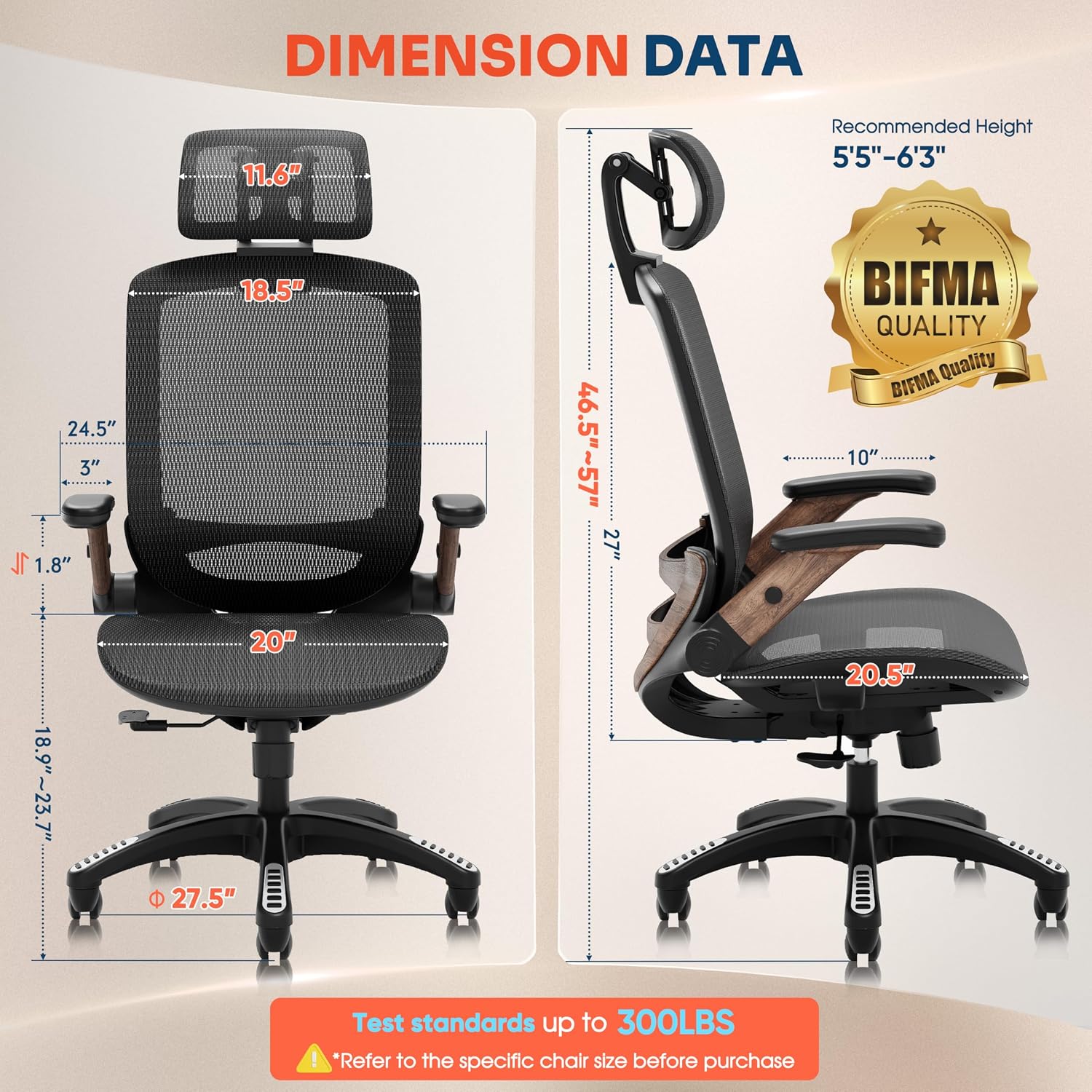
If you’ve ever bought an office chair rated for “400 lbs” only to feel it wobble and creak within a year, you’ve run into one of the most frustrating gaps in furniture marketing: the difference between a claimed weight capacity and a real one. Weight capacity, in this context, simply means the maximum load a chair is engineered to support safely — seat, back, armrests, and all — without structural failure or accelerated wear. The problem is that there’s no single mandatory standard forcing manufacturers to prove that number before printing it on the box. For larger-bodied users investing $300–$800+ in a chair they’ll sit in 8 hours a day, that’s not a minor detail — it’s the difference between a chair that lasts five years and one that’s a landfill candidate by month 18. This article breaks down how capacity claims are made, what third-party testing actually validates, and what real owners consistently report at the high end of the weight range.
| EDITOR'S PICK600LBS Large Heavy Duty Office… | Mid-tier[Indulgear 500lbs Big and Tall O…](https://www.amazon.com/dp/B0CDCQMGSH?tag=greenflower20-20) | Budget pick[CAPOT Ergonomic Mesh Office Cha…](https://www.amazon.com/dp/B0D9VPSQM7?tag=greenflower20-20) | |
|---|---|---|---|
| Weight Capacity | 600 lbs | 500 lbs | 400 lbs |
| Arm Type | 5D flip arms | — | 4D flip-up arms |
| Cushion Type | Pocket spring | Pocket spring | — |
| Wheel Type | — | Rubber | PU |
| Price | $218.02 | $161.48 | $161.40 |
| See on Amazon → | See on Amazon → | See on Amazon → |
How “Weight Capacity” Numbers Are Set — and Why They Vary Wildly
The standard that should anchor every office chair capacity claim is the BIFMA X5.1 — a test protocol published by BIFMA International (the Business and Institutional Furniture Manufacturers Association) that puts chairs through cyclic load tests, drop tests, and stability assessments. A chair passing BIFMA X5.1 at a given weight rating has, in principle, endured a simulated multi-year workload at that load.
The operative word is “should.” BIFMA certification is voluntary, not federally mandated for consumer chairs. Per BIFMA International’s published overview of their certification program, chairs sold through commercial contract channels (your employer buying 200 units for an office) are far more likely to carry genuine BIFMA certification than chairs sold direct-to-consumer on retail platforms. That’s why you can find a $189 chair on a big-box site claiming “500 lb capacity” sitting alongside a $600 commercial chair with the same printed number — and the commercial chair has the test data to back it, while the retail one may not.
The three tiers of capacity honesty you’ll encounter:
- BIFMA-certified at the stated weight — the claim is test-backed. Usually found on commercial-grade and contract chairs from brands like Sitmatic, Global Upholstery, and the heavy-duty lines from Eurotech.
- Manufacturer self-certified — the brand ran internal tests or simply assigned a number. Common in mid-range retail. Not necessarily wrong, but unverifiable.
- Marketing inflation — the number reflects a one-time static load (put a 400 lb weight on it and it doesn’t collapse) rather than dynamic, cyclical, real-world use. This is where chairs quietly fail at 18 months.
The distinction matters enormously once you’re shopping above 300 lbs. At lighter weights, many self-certified chairs hold up fine in practice. Above 400 lbs — and especially in the 500–700 lb range — the gap between a stress-cycled BIFMA rating and a static marketing number becomes structural.
By the Numbers: What You’re Actually Paying For at Each Tier
| Capacity Claim | Price Range (2026) | BIFMA Likely? | Realistic Lifespan (heavy daily use) |
|---|---|---|---|
| 250–300 lb (standard) | $150–$400 | Often yes, at major brands | 3–7 years |
| 350–400 lb (big & tall) | $280–$600 | Mixed — verify per model | 2–5 years |
| 450–500 lb (heavy-duty) | $450–$900 | Ask for documentation | 3–6 years (if certified) |
| 600–700 lb (bariatric) | $700–$1,800+ | More likely if medical-grade sourced | 4–8 years (certified units) |
What Real Owners Report at the 400–500 lb Range
Here’s where the marketing-versus-reality gap gets concrete. Ergonomic Trends’ buyer’s guide for big-and-tall chairs, which aggregates long-run owner reviews, identifies a consistent failure pattern: chairs rated at 400–500 lbs that fail structurally not at the seat pan or frame, but at the cylinder (gas lift) and the caster sockets. These are the two highest-stress contact points in a seated-and-moving user’s daily cycle, and they’re frequently the components where budget cuts show up in manufacturing.
The Spruce’s roundup of heavy-duty chairs notes that owners at 380–420 lbs frequently report gas cylinders losing height retention within 8–14 months on chairs in the $250–$400 range — even when the overall weight rating suggests headroom. The cylinder, in plain terms, is the hydraulic post your seat slides up and down on; when it loses tension, the chair slowly sinks during the workday, which is both uncomfortable and a sign of internal seal failure.
Forbes’ 2025 review of big-and-tall office chairs flagged a second recurring complaint at this weight tier: armrest hardware cracking or bending at welds. Users who rest a meaningful portion of their weight on armrests when sitting down or standing up — a natural movement pattern — place asymmetric lateral loads on armrest mounts that many chairs simply aren’t engineered for at 400+ lbs. The chairs that hold up in this category consistently share one spec: welded steel armrest brackets rather than plastic-integrated mounting systems.
Consumer Reports’ office chair testing methodology notes that armrest durability is one of the harder metrics to assess short-term, but that multi-year reader surveys consistently flag plastic mounting hardware as the first failure point on chairs used by heavier individuals.
The pattern across aggregated owner reports:
- Frames (the main skeleton) almost never fail catastrophically — they’re over-engineered for liability reasons
- Cylinders, casters, and armrest mounts fail first, and usually within 12–24 months on non-certified chairs
- Seat foam compression is a secondary complaint — bottoming out of cushion support — but typically takes 2–3 years to become a functional problem
The 500–700 lb Tier: Where Claims Get Riskiest
If you’re shopping at the genuine upper end — chairs rated for 500 lbs and above — the field narrows quickly, and the stakes of a wrong call are higher both financially and physically. A chair failure at 600 lbs isn’t just an inconvenience; it’s a fall-and-injury risk.
The chairs with the most credible owner-reported track records in this range tend to come from one of three sourcing paths:
1. Medical/bariatric contract suppliers that build for clinical and institutional environments — brands like Medline, Drive Medical, and specialty commercial lines from Global Upholstery. These chairs exist because hospitals and rehab facilities have liability exposure that demands real structural documentation. They’re not aesthetically exciting, but they carry paper trails.
2. Purpose-built heavy-duty task chairs from commercial brands that offer certified heavy-duty variants — Ergonomic Trends specifically calls out Eurotech’s iOO and the Sitmatic GoBIG series as chairs with legitimate BIFMA documentation at 500 lbs. Pricing lands in the $600–$950 range, which is meaningful spend but appropriate for what’s being asked structurally.
3. Custom-configured commercial bases — a small but growing category where buyers specify a commercial-grade five-star base (in steel, not nylon) with an uprated gas cylinder sourced separately, paired with a heavy-duty seat mechanism. This is the approach facilities managers use for institutional settings. It’s not a standard consumer path, but for buyers at 550–700 lbs who can’t find an off-the-shelf solution with documentation, it’s worth knowing it exists.
What to watch for in this tier: Ergonomic Trends’ guide notes that several popular Amazon-sold chairs in the 500–600 lb capacity range appear to share the same OEM base from Chinese manufacturing sources, with different brand labels applied. Owner reports on these chairs cluster around the same cylinder-and-caster failure timeline regardless of the brand name on the box — suggesting the capacity claim is being applied to an identical, unvalidated base across multiple SKUs.
How to Actually Validate a Capacity Claim Before Buying
At this point, you’ve got the decision frame. Here’s the practical sequence:
Step 1: Ask for BIFMA documentation. If a retailer or manufacturer can’t produce a test certificate or a BIFMA certification number on request, treat the claim as self-certified and price your expectations accordingly.
Step 2: Check the cylinder spec independently. A quality gas cylinder for heavy-duty use will be rated at the load capacity and will typically be a Class 4 cylinder at minimum. Some manufacturers publish cylinder specs; others won’t, which is itself a signal.
Step 3: Look for steel in the base and armrest mounts. Nylon five-star bases are fine for standard-weight users; at 400+ lbs, a steel or reinforced aluminum base dramatically changes the failure timeline. The spec sheet should call this out explicitly — if it doesn’t, ask.
Step 4: Read the warranty terms, not just the warranty length. A “5-year warranty” that excludes gas cylinders, casters, and “normal wear” covers almost nothing that actually fails on a heavy-use chair. Per Consumer Reports’ general guidance on furniture warranties, the component exclusion list is where manufacturers quietly limit exposure. Look for warranties that name the cylinder and base as covered components.
Step 5: Prioritize owner reports over 18+ months. Short-term reviews (under a year) almost never catch cylinder or caster failure — those failures are time-and-cycle dependent. Filter reviews by date and look for reports from users who explicitly mention their weight and how long they’ve owned the chair.
The Decision Rule
If your weight is under 350 lbs and you’re buying from an established brand (Steelcase, Herman Miller, Humanscale, Haworth), their standard product lines are almost certainly BIFMA-tested and will hold up under normal use without a specialized search. You don’t need the big-and-tall category — just buy a well-reviewed ergonomic chair in your price range.
If you’re in the 350–450 lb range, buy at the next capacity tier up from your actual weight, verify the cylinder spec is called out explicitly, and treat any chair without BIFMA documentation as a 2–3 year purchase, not a 5-year one. Budget accordingly.
If you’re at 500 lbs or above, treat unverified consumer-channel capacity claims as marketing noise. Your realistic options are commercial/bariatric suppliers with documentation, purpose-built heavy-duty lines from brands like Eurotech or Sitmatic, or a custom commercial base configuration. Expect to spend $700–$1,400 for something genuinely engineered for your use case. That’s real money — and it’s still far less than an ER visit or a year of back pain from a chair that slowly failed underneath you.
The capacity number on the label is a starting point, not a guarantee. The documentation, the component specs, and the long-run owner reports are where the truth lives.